(EN) JICA Trainee Scientific and Technical Knowledge Cluster
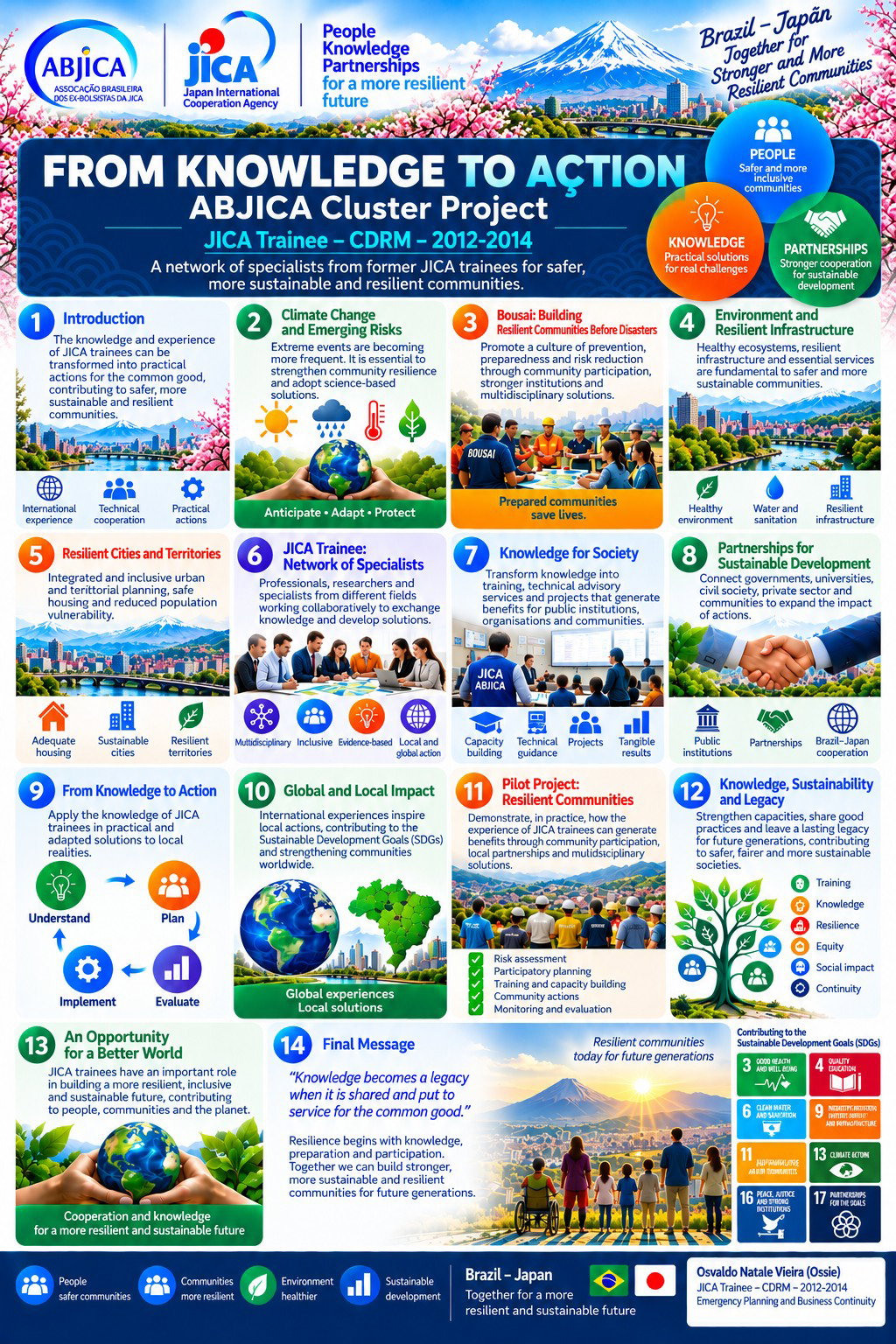
Connecting Global Expertise for the Common Good, Sustainable Development and Resilient Communities
Transforming international cooperation, scientific knowledge and professional experience into practical solutions for a safer, more inclusive and sustainable world. By Osvaldo Natale Vieira JICA Trainee – Comprehensive Disaster Risk Management (2012–2014) Emergency Planning & Business Continuity
1. Introduction: The Lasting Value of International Cooperation International cooperation is not simply about transferring knowledge between countries. Its greatest value lies in the lasting relationships, professional competencies and shared commitment to improving people's lives. For decades, the Japan International Cooperation Agency (JICA) has contributed to human resource development through technical cooperation, professional training, institutional partnerships and international knowledge exchange. Across the world, thousands of former JICA training participants have returned to their countries equipped with scientific knowledge, technical expertise, practical experience and a deeper understanding of Japan's approaches to sustainable development, disaster risk reduction, innovation and community resilience. These alumni represent a valuable international resource. However, an important opportunity remains: How can the knowledge and experience acquired through JICA programmes be connected, mobilised and transformed into coordinated action for the common good? One possible answer is the creation of a JICA Trainee Scientific and Technical Knowledge Cluster — a collaborative network bringing together former trainees, researchers, technical specialists and experienced professionals to support sustainable development, institutional capacity and community resilience.
2. The Vision: From Individual Knowledge to Collective Impact The proposed Knowledge Cluster is founded on a simple principle: Knowledge becomes more valuable when it is shared, and more powerful when it is applied to improve people's lives. Former JICA trainees work across a wide range of disciplines, including engineering, public health, environmental management, urban planning, education, disaster risk management, agriculture, technology, governance and social development. Individually, these professionals contribute to their organisations and communities. Collectively, they have the potential to establish a multidisciplinary network capable of addressing complex and interconnected development challenges. The proposed Cluster would create opportunities for alumni to:
- Connect scientific, technical and professional expertise across disciplines and countries.
- Exchange research, lessons learned, innovations and good practices.
- Support public institutions, universities, civil society organisations and local communities.
- Promote technical mentoring, professional development and collaborative learning.
- Develop practical initiatives that contribute to the United Nations Sustainable Development Goals.
- Strengthen disaster preparedness, climate adaptation and community resilience.
- Encourage voluntary professional contributions for the common good.
Rather than establishing a parallel institution, the Cluster would complement existing JICA Alumni Associations and professional networks, subject to their respective governance arrangements and institutional support.
3. Building a Global Network of Scientific and Technical Professionals The proposed Knowledge Cluster could operate as a network of multidisciplinary communities of practice, connecting professionals according to their expertise, interests and geographical areas. Eight initial thematic areas are suggested: 1. Housing and Social Development Promoting safe and adequate housing, social inclusion, sustainable settlements and the reduction of vulnerability among disadvantaged populations. 2. Urban and Territorial Planning Supporting resilient land-use planning, sustainable urban growth, risk-sensitive development and stronger integration between urban and rural communities. 3. Infrastructure and Essential Services Sharing technical expertise on water, sanitation, drainage, transport, energy, waste management and the continuity of essential services. 4. Disaster Risk Reduction, Bousai and Community Resilience Advancing disaster prevention, preparedness, early warning, emergency planning, risk communication and community-led resilience initiatives. 5. Environment, Climate Change and Sustainability Encouraging climate adaptation, environmental protection, ecosystem-based approaches and sustainable resource management. 6. Governance, Public Policy and Institutional Development Supporting evidence-based decision-making, institutional capacity, transparent governance, community participation and effective public policies. 7. Smart Cities, Science, Technology and Innovation Promoting geospatial information, digital technologies, research, data analysis, innovation and accessible solutions for local development. 8. International Cooperation, Education and Capacity Building Strengthening professional exchanges, mentoring, technical education and cooperation between Japan, alumni networks, academic institutions and development partners. These thematic groups would encourage cross-disciplinary collaboration, recognising that challenges such as climate change, urban vulnerability and disaster risk cannot be effectively addressed through isolated professional approaches.
4. Bousai: Japanese Knowledge Supporting Resilient Communities One particularly valuable contribution of Japan's international cooperation is the concept of Bousai, broadly associated with disaster prevention, preparedness and risk reduction. Japan's experience demonstrates the importance of combining scientific understanding, engineering, institutional coordination, public education and community participation to reduce disaster impacts. Through JICA training programmes, professionals from many countries have been introduced to Japanese approaches to disaster risk management and resilience. The proposed Knowledge Cluster could help translate these experiences into locally appropriate initiatives, including:
- Participatory community risk and vulnerability assessments.
- Public awareness and disaster preparedness education.
- Community emergency planning and evacuation exercises.
- Early warning communication and risk information.
- Protection of vulnerable populations.
- Business continuity and resilience of essential services.
- Climate adaptation and resilient urban development.
- Recovery planning and the principle of building back better.
A central consideration is that resilience begins with people, is strengthened by institutions and becomes sustainable through connected communities. The Cluster could promote a three-level approach to protection: First level – Individuals and Families: Strengthening risk awareness, preparedness, personal safety and inclusive protection. Second level – Institutions and Essential Services: Improving organisational preparedness, emergency planning, business continuity and professional capabilities. Third level – Communities and Territories: Supporting collective action, local partnerships, resilient infrastructure and sustainable territorial development. Together, these levels provide a practical foundation for developing safer and more resilient societies.
5. Contributing to the United Nations Sustainable Development Goals The proposed Knowledge Cluster would support the principles of the United Nations 2030 Agenda for Sustainable Development by encouraging the practical application of professional expertise to local and global challenges. Its activities could contribute particularly to: Sustainable Development Goal Potential Cluster Contribution SDG 3 – Good Health and Well-being Public health preparedness and community protection SDG 4 – Quality Education Technical training, mentoring and knowledge exchange SDG 6 – Clean Water and Sanitation Sustainable water management and essential infrastructure SDG 9 – Industry, Innovation and Infrastructure Resilient infrastructure and technological innovation SDG 11 – Sustainable Cities and Communities Risk-sensitive urban planning and resilient communities SDG 13 – Climate Action Climate adaptation, preparedness and disaster risk reduction SDG 16 – Peace, Justice and Strong Institutions Institutional capacity, governance and accountability SDG 17 – Partnerships for the Goals International technical cooperation and multidisciplinary partnerships Importantly, the Cluster would encourage the translation of broad international development commitments into locally relevant, measurable and community-centred actions.
6. The Common Good: Professional Knowledge as a Shared Responsibility Scientific knowledge and technical expertise carry responsibilities beyond individual professional achievement. Engineers, scientists, public health specialists, educators, planners, emergency managers and researchers possess skills that can help communities understand risks, overcome vulnerabilities and build more sustainable futures. The proposed Cluster would encourage a culture of voluntary professional contribution, grounded in ethical practice, mutual respect, scientific evidence and public benefit. This approach would not replace the responsibilities of governments, emergency services or established institutions. Instead, it would offer complementary expertise, professional collaboration and knowledge-sharing opportunities, particularly where local authorities and communities may benefit from additional technical capacity. Participation should remain voluntary, inclusive and subject to appropriate safeguarding, professional standards, data protection requirements and institutional arrangements. The ultimate objective is not merely to establish another professional network, but to cultivate a community of practice in which knowledge serves society.
7. From Concept to Practice: A Community Resilience Pilot To demonstrate the practical value of the proposed Cluster, an initial pilot project could be developed through ABJICA in Brazil, subject to institutional consideration, local partnerships and available resources. The pilot, provisionally titled “Resilient Communities: From Knowledge to Action,” could follow five stages. Stage 1 – Community Diagnosis: Identify local hazards, vulnerabilities, existing capacities and priority needs through participatory assessment. Stage 2 – Technical Mobilisation: Connect JICA alumni, multidisciplinary professionals, local government representatives, universities and community organisations. Stage 3 – Collaborative Planning: Co-design appropriate tools, educational materials, technical guidance and locally relevant resilience measures. Stage 4 – Community Action: Deliver workshops, awareness activities, preparedness initiatives and practical interventions in cooperation with responsible institutions. Stage 5 – Evaluation and Knowledge Sharing: Assess results, document lessons learned and identify approaches that could be adapted and replicated elsewhere. This pilot would provide an opportunity to demonstrate how international training experience can generate practical benefits for communities while strengthening professional cooperation.
8. Strengthening JICA Alumni Associations and International Partnerships
JICA Alumni Associations play an important role in maintaining relationships among former training participants and promoting continued engagement with Japan. The proposed Cluster could offer an additional mechanism for connecting these associations through technical collaboration and shared professional interests. In Brazil, the Associação Brasileira dos Ex-Bolsistas da JICA (ABJICA) could provide a potential institutional setting for discussing and developing an initial model. With appropriate institutional consultation, lessons learned could subsequently be shared with other JICA Alumni Associations interested in similar approaches. Potential partners may include national and local governments, universities, research institutions, professional associations, civil society organisations, private-sector specialists and community representatives. Such collaboration could strengthen the long-term impact of international cooperation by connecting training outcomes with ongoing professional practice and local development priorities.
9. A Proposed Framework for Implementation
The development of the Knowledge Cluster would require a clear, proportionate and transparent governance framework. A possible initial structure could include:
- Institutional Oversight: Alignment with the relevant Alumni Association's objectives and governance arrangements.
- Cluster Coordination: Facilitation of professional networking, technical activities and partnerships.
- Technical Advisory Group: Voluntary specialists providing scientific and professional guidance.
- Thematic Working Groups: Multidisciplinary teams organised around priority development areas.
- Regional Focal Points: Support for local engagement and identification of practical opportunities.
- Institutional Partners: Organisations contributing technical expertise, research, facilities or other appropriate resources.
An indicative first-year programme could focus on institutional consultation, mapping alumni expertise, establishing technical groups, identifying a pilot community, implementing initial activities and evaluating results. The development process should remain flexible, with clear responsibilities, realistic resources and measurable objectives.
10. Measuring Sucess through Community Impact
The long-term value of the Knowledge Cluster should be assessed not simply by the number of professionals participating, but by the benefits generated through collaboration. Potential indicators include the number of active alumni specialists, technical working groups, institutional partnerships, training activities, participating communities, practical tools developed and pilot initiatives completed. Qualitative measures would also be important, including improvements in local preparedness, professional cooperation, institutional learning, community participation and the practical application of knowledge. Monitoring and evaluation should help identify what works, what requires improvement and which approaches may be suitable for wider adoption.
11. A shared opportunity to the future
The knowledge acquired through international cooperation should not end when a training programme concludes. It can continue to grow through professional practice, scientific research, mentoring, collaboration and community engagement. The proposed JICA Trainee Scientific and Technical Knowledge Cluster represents an opportunity to connect this experience across disciplines and generations, strengthening the contribution of alumni to sustainable development and community resilience. Its success would depend on institutional engagement, voluntary participation, mutual trust, scientific integrity and a shared commitment to the common good. By connecting people, knowledge and institutions, JICA alumni have the potential to contribute to a wider culture of prevention, preparedness, innovation and sustainable development. From knowledge to action. From individual expertise to collective impact. From international cooperation to stronger and more resilient communities. This is the vision behind the proposed Knowledge Cluster.
About the Author
Osvaldo Natale Vieira is a JICA alumnus who participated in training in Comprehensive Disaster Risk Management between 2012 and 2014. He has professional experience in Brazil, Japan and the United Kingdom and currently works as an Emergency Planning Officer and Business Continuity Lead at Herefordshire Council, United Kingdom. His professional interests include comprehensive disaster risk management, emergency preparedness, business continuity, community resilience, international technical cooperation and sustainable development.
Editorial Note
This article presents an independent technical proposal for discussion and potential collaboration. The JICA Trainee Scientific and Technical Knowledge Cluster is a proposed initiative and should not be interpreted as an officially established or endorsed programme of JICA, ABJICA or other JICA Alumni Associations. October 2026